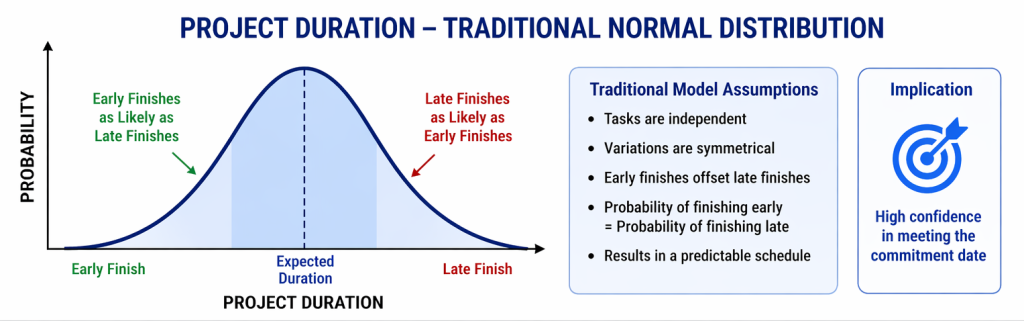
There is a deceptively simple formula at the foundation of traditional project scheduling: σ²_total = Σσᵢ², which implies that project uncertainty grows in proportion to the square root of the number of tasks. It assumes that project duration uncertainty is simply the sum of individual task variances.
Mathematically elegant. Operationally dangerous.
Why? Because this formula is only valid under one critical condition:
Tasks in execution must be independent of other tasks and resources.
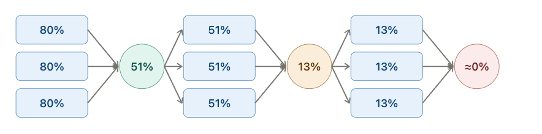
In real projects, both Task and Resources are definitely not independent.
The Hidden Assumption That Breaks Everything
The classical model treats projects as:
- a collection of independent tasks
- executed by independent resources
- with uncertainty that cancels out over time
 But real projects behave very differently.
They are:
- tightly interdependent networks
- driven by shared, constrained resources
- subject to feedback loops, merge points, and rework
The result?
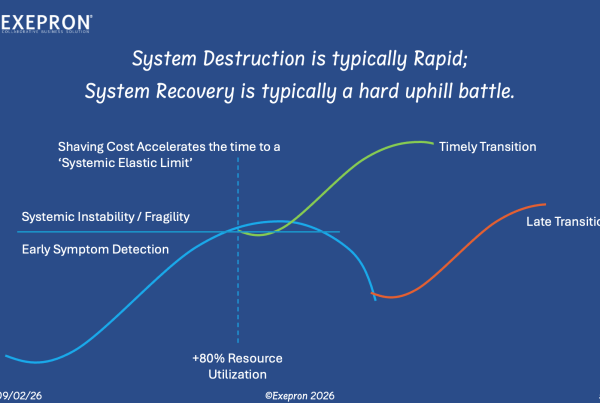
Uncertainty does not cancel out. It compounds.
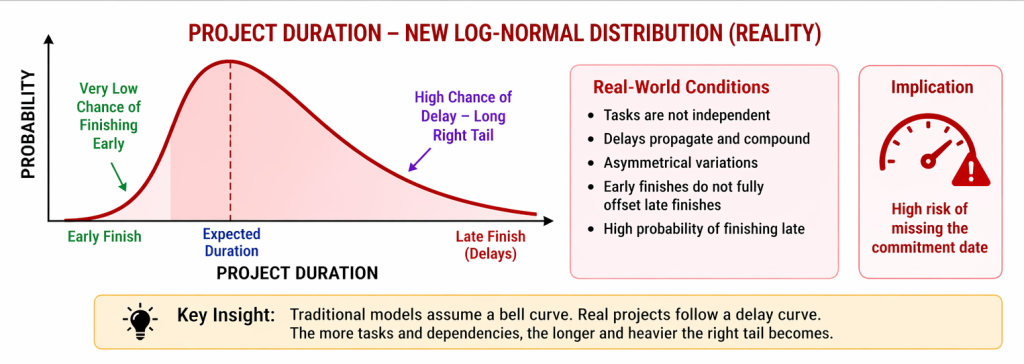 And that gap between assumption and reality is where billions are lost in:
- cost overruns
- missed deadlines
- expediting
- rework
- lost opportunity
- project cancelation
The Six Missing Factors
The classical model ignores six structural realities:
- Dependency Coupling – Tasks are interconnected; delays propagate
- Merge Point Collapse – Parallel paths merge to reduce reliability exponentially
- Resource Contention – Shared resources create queuing delays
- WIP Overload – Too much WIP clogs everything
- Multitasking – results in wasted stop/start, wasted effort
- Variability Amplification – Uncertainty accumulates across the network
Resulting Rework & Feedback Loops – Work cycles mean work not flowing linearly
Why Traditional Methods Struggle
Traditional scheduling attempts to compensate with:
- more detail
- more reporting
- more coordination
These actions increase coupling lockup and noise, not signal, further reducing control.
How CCPM Changes the Game
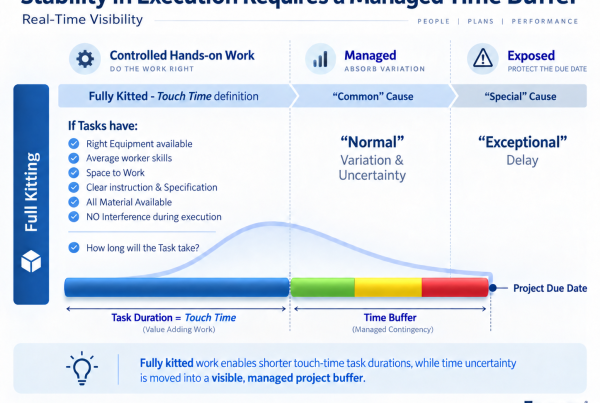
Critical Chain Project Management (CCPM) does not try to eliminate uncertainty.
It prepares the system to absorb and control it:
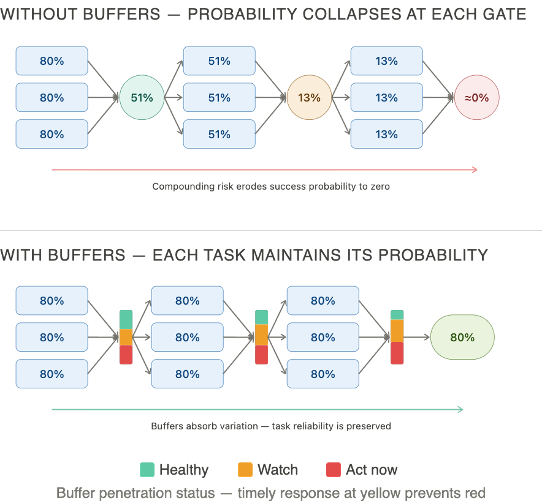
- Project & Feeding Buffers → absorb variability and manage protect merges
- Critical Chain Scheduling → resolves resource contention in planning
- Reporting Remaining Durations → provides real-time intelligence of decisions
- WIP Control → reduces multitasking and congestion
- Full Kitting → significantly improves uninterrupted execution
- Early Warning Signals → detect risk before propagation
- Signal-Based Reporting → replaces noise with actionable insight
 Why Exepron Matters
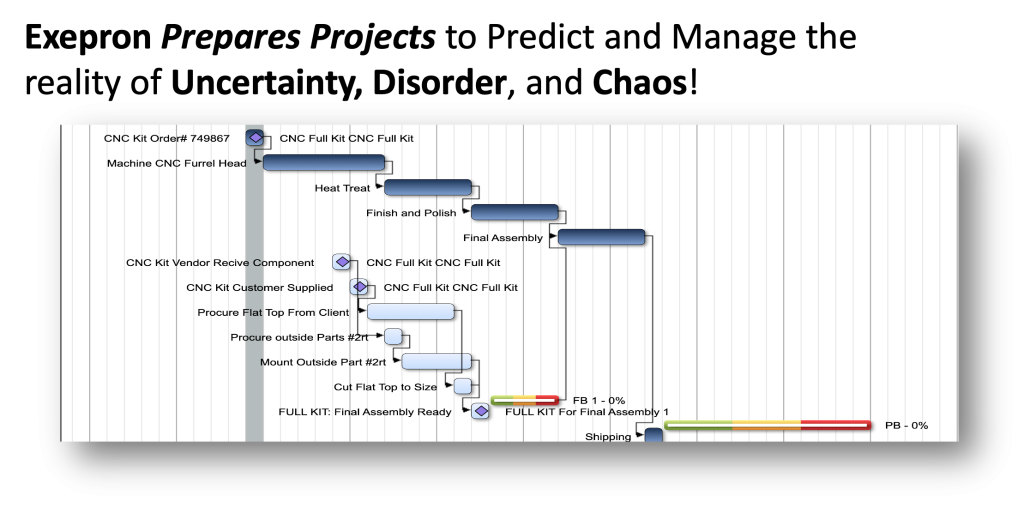
Exepron operationalizes CCPM into a real-time execution system:
- Dynamic Workflow Days (WIP vs capacity) → controls flow stability
- Buffer health monitoring → provides early warning
- Prioritization Intervention → red Tasks requiring immediate attention
- Portfolio resource visibility → prevents systemic overload across the portfolio
- Remaining-duration control → reflects execution reality
This transforms project management from:
- Task tracking to Flow control.
- Reactive to Predictive.
 The Bottom Line
For 10 Task or Throusands of tasks in a projects the CCPM method is valid, the issue was never poor execution. It was based on flawed assumptions.
Projects are not collections of independent tasks.
They are dynamic systems of interacting constraints, interferance, and resource limitations.
A Professional Recommendation
For those who want to understand the root of the problem—not just the symptoms—here is a link to the full in-depth study. This brief clearly demonstrates why late delivery and budget overruns are not anomalies, but predictable outcomes of the classical project management model.
Click here:
The Six-Factor Model of Project Schedule Uncertainty
The formula is mathematically correct, but it does not apply to real-world projects, as its underlying assumptions are insufficient.
Contact Exepron here to understand how this capital model applies to your environment.
About the Author
John L. Thompson is COO and co-founder of Exepron and a practitioner of the Theory of Constraints with over 40 years of experience helping organizations improve flow, reduce lead times, and increase Asset Productivity.
email: JohnT@Exepron.com
Exepron: for Logistic-Driven Organizations.
Find out how to significantly reduce lead time and provide reliable delivery at exepron.com
Let’s explore if there’s a fit for your organization.
We invite you to test the Exepron. We’ll bring the method, the technology, and the support. You bring the willingness to differentiate, retool operations, and lead cohesively.